Technology & Innovation
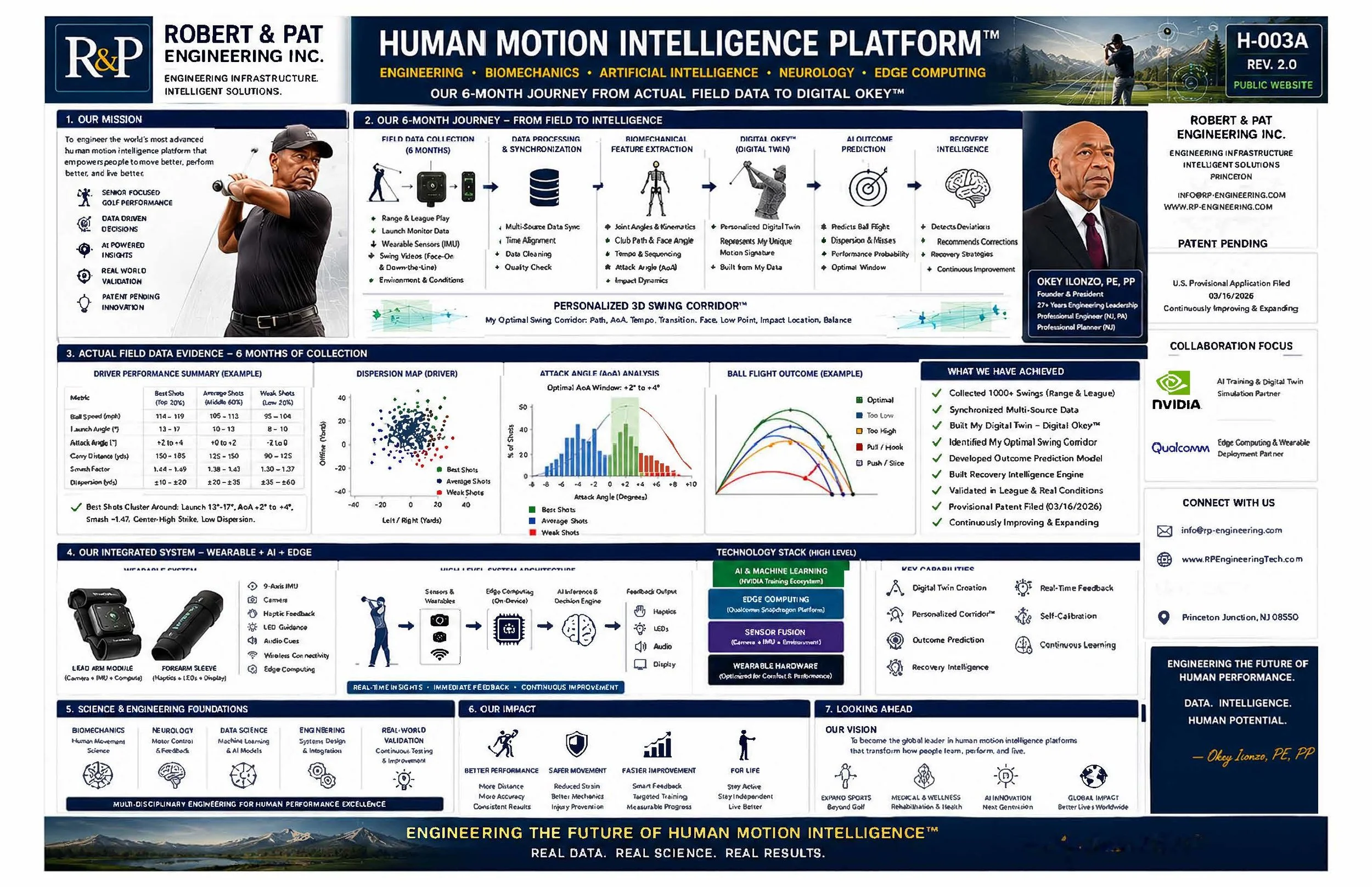
Engineering the Future Through Artificial Intelligence
RPEngineering Inc. is committed to advancing the future of engineering through the integration of Artificial Intelligence (AI), Digital Twins, Computer Vision, Sensor Fusion, Edge Computing, and Human Motion Intelligence technologies.
Our innovation strategy combines decades of engineering experience with emerging computational technologies to create intelligent systems capable of understanding, predicting, and optimizing complex physical and human interactions.
As engineering systems become increasingly connected and data-driven, our focus is on developing practical solutions that transform raw data into actionable intelligence for infrastructure, environmental systems, industrial applications, and human performance.
Artificial Intelligence & Digital Intelligence
Artificial Intelligence is transforming how engineering problems are analyzed and solved. RPEngineering Inc. is exploring the application of machine learning, predictive analytics, computer vision, and intelligent decision-support systems to enhance engineering design, monitoring, and operational efficiency.
Our objective is to leverage AI technologies to improve performance prediction, risk assessment, operational awareness, and real-time decision-making across a broad range of engineering and technology applications.
Areas of interest include:
Predictive analytics and forecasting
Intelligent monitoring systems
Machine learning applications
Computer vision and image interpretation
Sensor-driven decision support
AI-assisted engineering analysis
Infrastructure intelligence systems
Digital Twins and Simulation Technologies
Digital Twin technology enables the creation of virtual representations of physical systems, allowing engineers to model, simulate, analyze, and optimize performance before real-world deployment.
RPEngineering Inc. is pursuing Digital Twin methodologies to support engineering analysis, infrastructure evaluation, environmental modeling, and human motion research.
By combining real-world data with simulation environments, Digital Twins can improve system understanding, reduce development risk, accelerate innovation, and support data-driven decision making.
Potential applications include:
Infrastructure system modeling
Transportation and mobility analysis
Environmental system simulation
Predictive maintenance strategies
Human movement and biomechanics research
Engineering optimization studies
High-Performance AI Development
Advanced AI development requires powerful computational platforms capable of processing large datasets, performing simulation studies, and training sophisticated machine learning models.
RPEngineering Inc. is investigating the use of advanced AI computing environments to support:
Large-scale simulation workflows
Synthetic data generation
Digital Twin development
Computer vision model training
Predictive intelligence systems
Human motion analytics
These technologies provide the foundation for creating intelligent systems capable of learning from complex data and adapting to dynamic operating conditions.
Edge Computing and Real-Time Intelligence
The future of intelligent systems extends beyond the cloud.
Edge Computing enables advanced AI models to operate directly on local devices, reducing latency, improving responsiveness, increasing privacy, and minimizing dependence on continuous cloud connectivity.
RPEngineering Inc. is exploring next-generation edge-computing architectures capable of supporting:
Real-time sensor processing
Intelligent wearable technologies
Embedded AI systems
Autonomous decision support
Field-based monitoring applications
Mobile and portable engineering platforms
This approach allows intelligence to move closer to the user, enabling faster and more efficient operation in real-world environments.
Human Motion Intelligence™
One of the company's emerging technology initiatives is Human Motion Intelligence™, an engineering framework focused on understanding, analyzing, and improving human movement through the integration of sensing technologies, AI analytics, and real-time feedback systems.
Human Motion Intelligence™ combines principles from engineering mechanics, biomechanics, sensor technology, computer vision, and artificial intelligence to develop advanced solutions capable of monitoring and interpreting movement patterns.
Potential applications include:
Sports performance analysis
Training and coaching technologies
Motion assessment systems
Rehabilitation support tools
Occupational movement studies
Wellness and human-performance applications
Future medical and healthcare technologies
The initiative represents a convergence of engineering, data science, and human-centered technology designed to create safer, smarter, and more adaptive motion-intelligence solutions.
Research, Development, and Strategic Partnerships
Innovation is most effective when supported by collaboration.
RPEngineering Inc. actively seeks opportunities to collaborate with technology companies, research organizations, universities, engineering firms, and strategic industry partners interested in advancing artificial intelligence, digital twin technologies, edge computing, and human motion intelligence applications.
The company continues to evaluate emerging technologies while maintaining a strong commitment to engineering excellence, intellectual property protection, practical innovation, and responsible technology development.
Our Vision
To bridge the gap between traditional engineering and next-generation intelligent systems by developing technologies that enhance infrastructure, improve decision-making, optimize performance, and expand human potential through innovation.
At RPEngineering Inc., we believe the future of engineering lies at the intersection of physical systems, digital intelligence, and human-centered technology.